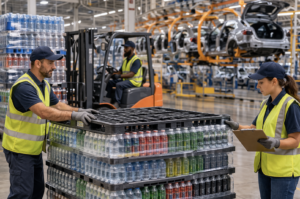
The automotive supply chain depends on timing, consistency, and protection at every stage. Raw materials have to move in predictable ways. Parts have to arrive without damage. Warehouses have to receive, stage, and ship loads without creating extra friction. In that environment, pallets are not a background detail. They are part of the physical system that keeps production, storage, and delivery moving.
That matters because the broader automotive industry is one of the largest and most interconnected manufacturing ecosystems in the world, and recent coverage across the sector keeps showing how sensitive it remains to trade rules, supplier disruption, logistics pressure, and component availability. Reuters coverage of automakers planning major U.S. investments while seeking clearer trade rules, AP News reporting on tariffs rippling through North American auto supply chains, and Supply Chain Dive coverage of the USITC’s review of USMCA auto rules all point to the same reality: small inefficiencies become large problems when supply networks are under pressure.
That is exactly why a pallet partner deserves more attention than many companies give it. A strong pallet program supports throughput, protects freight, reduces handling issues, and helps create a more disciplined flow of goods across plants, warehouses, and distribution points. When you look closely, the value of a pallet manufacturer is not limited to wood and nails. It is tied to uptime, labor efficiency, inventory protection, and the credibility of the entire shipping operation.
Packaging Reliability Is a Supply Chain Advantage
Automotive companies spend significant time thinking about sourcing, transportation, sequencing, and supplier performance. They think about line-side inventory, service levels, lead times, and freight costs. What often gets overlooked is that pallets influence all of those areas because they affect how product is loaded, stacked, moved, scanned, stored, and unloaded.
A manufacturer that serves beverage operations understands something automotive companies can use immediately: volume pressure. Beverage distribution is fast, repetitive, and unforgiving. Loads move in dense, high-frequency environments where damage, inconsistency, and poor pallet performance show up quickly. That makes a proven Beverage Pallet Manufacturer relevant to automotive supply chain thinking, because the same strengths that help beverage logistics succeed also support automotive operations that need dependable material handling and fewer avoidable disruptions.
When a pallet is built to consistent dimensions and reliable performance standards, it supports smoother forklift handling, better trailer utilization, safer stacking, and more predictable warehouse movement. That reduces the small operational failures that quietly drain money from a supply chain. It also helps create repeatability across locations, which is essential for automotive businesses that manage multiple suppliers, multiple facilities, and multiple modes of transport.
Damage Prevention Protects More Than Inventory
In the automotive world, a damaged load is rarely just a damaged load. It can become a receiving delay, a production delay, a claim issue, a customer-service problem, or a cost overrun that never gets fully traced back to the original cause. Parts, components, service kits, fluids, and packaged materials all rely on stable transport conditions. If the pallet under the load is weak, inconsistent, or poorly matched to the product, the risk expands quickly.
This point becomes even more important when supply chains are already strained. Manufacturing Dive reporting on expanded chip capacity for automotive demand reflects how closely automotive production depends on the availability and protection of critical components, while IndustryWeek’s analysis of 2026 supply chain risks highlights continuing exposure to trade policy, geopolitical pressure, infrastructure issues, and other operational threats. In that kind of environment, companies cannot afford preventable packaging failures inside their own logistics network.
A reliable pallet program helps protect the load from shifting, sagging, bottom-deck weakness, and handling damage during normal operations. That matters for inbound raw materials and outbound finished goods alike. It also matters for aftermarket automotive distribution, where order accuracy and condition on arrival affect customer confidence and repeat business. A better pallet can reduce breakage, improve load stability, and preserve product integrity from dock to dock.
Warehouse Efficiency Starts with Better Unit Loads
Automotive companies invest heavily in warehouse processes, scanning systems, slotting strategies, and labor management. Those systems work best when the physical loads moving through the building are consistent. If pallet quality varies from shipment to shipment, warehouse teams lose time adjusting fork placement, restacking product, dealing with damaged units, and navigating safety concerns.
That is where pallet design becomes operational strategy. Proper deck spacing, dependable board quality, consistent footprint, and adequate load-bearing performance help warehouses move faster with fewer interruptions. The goal is not simply to have something under the product. The goal is to have a platform that supports faster turns, safer movement, and cleaner execution.
Recent automotive supply chain coverage reinforces how valuable that kind of discipline can be. Supply Chain Dive’s reporting on Toyota suppliers seeking relief from USMCA review underscores how much attention the industry is giving to every link in North American supply networks. When trade policy, sourcing pressure, and transportation cost are all being scrutinized, it makes little sense to ignore the pallet system carrying the load through the warehouse.
Automotive supply chains are filled with hidden labor costs. A broken or inconsistent pallet can create manual touches that never show up on a line item called “pallet problem.” Instead, the cost shows up in slower unloading, lost time, repacking labor, product claims, and avoidable friction on the dock. A stronger pallet strategy helps remove those hidden costs before they spread.
Standardization Helps Multi-Site Automotive Operations
Automotive businesses do not operate in a single isolated warehouse. They often manage regional distribution centers, supplier networks, manufacturing sites, third-party logistics partners, and service channels that all depend on standard operating expectations. Standardization matters because it improves predictability. Predictability improves speed. Speed supports cost control and customer satisfaction.
A pallet supplier that understands high-volume performance can support standardization across locations. That means more consistent specs, better repeatability, and fewer surprises when loads move from one site to another. It also helps packaging engineers, operations managers, and procurement teams speak the same language when evaluating material-handling performance.
This matters in a time when automotive companies are already adapting to policy and sourcing shifts. Recent industry reporting shows manufacturers and suppliers watching trade frameworks, sourcing strategy, and competitive positioning closely. When those larger forces are in motion, businesses benefit from stabilizing the pieces they can control inside their own network. Pallets fall into that category. They are not glamorous, but they influence flow, safety, handling, and execution every day.
Supplier Credibility and Sustainability Also Matter
Automotive companies are under increasing pressure to work with suppliers that can demonstrate reliability, documentation, and operational discipline. A pallet partner contributes to that picture by showing quality consistency, service responsiveness, and a clear understanding of the customer’s environment. The right partner is not just delivering pallets. That partner is helping support plant rhythm, warehouse performance, and transportation confidence.
Sustainability also enters the conversation. Many automotive organizations want suppliers that can support responsible material use, pallet recovery, repair programs, efficient design, and less waste across the shipping cycle. A pallet provider that takes these areas seriously can strengthen the customer’s broader supply chain story, especially when procurement and operations teams are evaluating total value instead of the lowest initial unit price.
That ties back to trust. In automotive logistics, trust is built when suppliers do what they say they will do, deliver consistent outputs, and help reduce noise in the system. A dependable pallet manufacturer can support that trust by improving how loads move and how well packaging holds up over time. Those gains may not always be dramatic in a single shipment, but they become meaningful when multiplied across thousands of movements.
The Best Pallet Programs Reduce Invisible Costs
One reason pallet strategy gets undervalued is that the cost of failure is spread out. It shows up in rework, minor delays, damaged goods, slower putaway, safety issues, and strained warehouse productivity. Those costs do not always arrive as a single obvious invoice, which makes them easy to underestimate.
A better pallet program changes that equation. It helps protect freight. It supports smoother handling. It can improve trailer efficiency and reduce the operational drag that comes from unstable or inconsistent unit loads. In a supply chain as demanding as automotive, those improvements matter because they add up across purchasing, receiving, storage, fulfillment, and delivery.
Automotive companies do not need every supplier to be flashy. They need suppliers that reduce friction. That is why a manufacturer with deep experience in demanding, high-throughput pallet environments deserves a place in the conversation. The closer an automotive company looks at uptime, warehouse flow, damage prevention, and supplier consistency, the more obvious that value becomes.
Conclusion
A pallet is not just a shipping accessory in the automotive world. It is part of the infrastructure that supports movement, protection, and execution. When pallets fail, the supply chain feels it. When pallet quality is consistent, operations become more stable, labor becomes more efficient, and loads arrive in better condition.
That is why a beverage-focused pallet manufacturer can matter so much to the automotive supply chain. Experience in fast-moving, high-volume distribution translates into real value for automotive operations that depend on repeatability and control. In a market where supply chains remain sensitive to trade changes, sourcing pressure, and operational disruption, stronger pallet performance is not a minor detail. It is a practical advantage that helps the whole system work better.