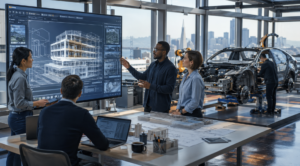
San Francisco has always been a city shaped by innovation, movement, and reinvention. From its dense urban streets to its fast-changing transportation needs, the city continues to push businesses to think differently about how they design, build, renovate, and operate their facilities. For the automotive industry, that pressure is even greater. Dealerships, service centers, EV charging locations, repair shops, parts facilities, fleet hubs, and automotive technology companies all need spaces that work harder, use land more efficiently, and support modern customer expectations.
The challenge is that building in San Francisco is rarely simple. Space is limited, regulations are detailed, construction costs are high, and every delay can become expensive. Automotive businesses that want to grow, remodel, or improve operations need better planning before construction begins. That is where Building Information Modeling, commonly known as BIM, has become one of the most valuable tools available.
BIM is not just design software. It is a smarter way to plan and coordinate buildings before teams ever step onto the job site. It helps architects, engineers, contractors, owners, and facility managers see how every major building system fits together. For San Francisco’s automotive industry, BIM can help reduce surprises, improve communication, shorten timelines, and create facilities that are ready for the future of mobility.
Companies that rely on San Francisco BIM Services can gain a clearer view of their projects before costly construction problems appear. Whether the project involves a new dealership, a service bay expansion, an EV charging installation, or a mixed-use automotive facility, BIM gives decision-makers the information they need to build faster and smarter.
Why San Francisco’s Automotive Industry Needs Smarter Building Solutions
The automotive industry in San Francisco is changing quickly. The rise of electric vehicles, autonomous technology, shared mobility, and cleaner transportation infrastructure is reshaping what automotive facilities need to support. Traditional auto buildings were often designed around sales floors, repair bays, storage areas, and parking. Today, those same facilities may also need EV chargers, battery-safe service areas, advanced electrical systems, digital customer check-in zones, improved ventilation, and space for new technology.
San Francisco’s own transportation priorities reflect this shift. The city has continued investing in cleaner mobility and electric vehicle infrastructure, including curbside EV charging efforts described by the San Francisco Municipal Transportation Agency. As more EV-related infrastructure becomes part of the urban environment, automotive businesses must think beyond simple square footage. They need facilities that can handle more complex electrical loads, safer vehicle movement, improved customer flow, and long-term flexibility.
Automotive companies also face a difficult real estate environment. In a dense city like San Francisco, there is little room for wasted space. A dealership service department may need to fit more lifts into an existing footprint. A fleet operator may need better circulation for vehicles entering and exiting the property. A repair facility may need to update mechanical systems without shutting down operations for long periods of time. A charging provider may need to coordinate equipment, utility connections, pedestrian clearances, and curbside conditions.
BIM helps automotive businesses address these problems early. Instead of relying only on flat drawings, project teams can work from intelligent 3D models that show how walls, structural elements, mechanical systems, electrical equipment, plumbing, doors, lifts, chargers, and circulation paths relate to one another. That clarity is especially useful in automotive spaces, where even small layout problems can affect productivity, safety, and revenue.
How BIM Helps Automotive Facilities Build Faster
One of the biggest advantages of BIM is speed. Construction projects often slow down when teams discover problems late in the process. A duct may conflict with a beam. Electrical equipment may not have enough clearance. A service bay layout may interfere with vehicle movement. A charger installation may require more coordination than expected. When these issues are discovered during construction, they can trigger change orders, redesigns, delays, and higher costs.
BIM reduces that risk by allowing project teams to identify conflicts before construction begins. Through clash detection and model coordination, BIM teams can compare architectural, structural, mechanical, electrical, and plumbing systems in one coordinated environment. This makes it easier to find and fix problems while they are still digital, rather than waiting until crews are already in the field.
For San Francisco automotive projects, this can be especially valuable because job sites are often tight and complicated. A dealership remodel may need to stay open while construction happens. A repair shop may have limited staging space. An EV charging project may need to coordinate with city rules, sidewalks, parking areas, electrical equipment, and public access. BIM gives contractors and owners a better roadmap, which can help reduce confusion and improve sequencing.
The broader construction industry has recognized BIM as a powerful tool for improving project planning and lifecycle management. The Wikipedia page on Building Information Modeling explains how BIM involves digital representations of physical and functional characteristics of places. In practical terms, that means project teams are not just drawing a building; they are building a digital version of it first.
That digital version can help automotive companies make better decisions earlier. Instead of discovering during construction that a service area feels too cramped or that equipment access is limited, owners can review the model, understand the layout, and request changes before those changes become expensive.
Improving Service Centers, Dealerships, and EV-Ready Spaces
Automotive facilities are operational buildings. They are not just places that look good from the outside. They must support daily work, customer movement, technician productivity, vehicle storage, parts organization, safety standards, and future technology. BIM helps owners and project teams design with those operational needs in mind.
For service centers, BIM can help coordinate lift placement, tool areas, exhaust systems, compressed air, drainage, lighting, ventilation, fire protection, and technician pathways. A well-coordinated service department can improve workflow and reduce wasted movement. When technicians can move efficiently and equipment is located correctly, the building supports productivity instead of slowing it down.
For dealerships, BIM can help balance showroom design with back-of-house needs. Customer-facing spaces need to feel modern and professional, but the building also needs strong operational support. BIM can help coordinate offices, sales areas, service write-up lanes, waiting rooms, restrooms, parts departments, and vehicle delivery areas. This matters in a market where customer experience can influence trust, reviews, and repeat business.
For EV-focused facilities, BIM is even more important. Electric vehicle infrastructure often requires careful planning around power capacity, charger location, conduit routing, equipment clearance, accessibility, and future expansion. The California Energy Commission has long supported clean transportation investment, which shows how important infrastructure planning is becoming across the state. Automotive businesses in San Francisco that want to stay competitive need buildings that can adapt as charging demand grows.
BIM gives owners a way to plan for that future. Instead of adding EV infrastructure as an afterthought, project teams can model it into the facility strategy from the beginning. This can help avoid costly rework, reduce disruption, and create a more scalable building.
Supporting Autonomous Vehicle and Mobility Technology Growth
San Francisco and the broader Bay Area are closely tied to the future of autonomous vehicles, mobility platforms, and transportation technology. While not every automotive business is directly involved in autonomous vehicle development, the industry as a whole is being influenced by the shift toward smarter transportation systems. News coverage from outlets like Reuters continues to show how active the global automotive and autonomous vehicle sectors remain.
Facilities that support this changing industry may need more than traditional garage space. They may require data rooms, testing areas, secure vehicle storage, calibration zones, charging areas, specialized equipment rooms, and flexible layouts that can change as technology changes. BIM helps these facilities become more adaptable because it allows teams to plan complex systems together.
In automotive technology environments, coordination is critical. A facility may need strong electrical systems, low-voltage infrastructure, security systems, HVAC support, and specialized access controls. BIM can help coordinate those systems so that the finished space is not only buildable but also practical for long-term operations.
This is especially important in San Francisco, where automotive-related businesses may operate in older buildings, tight urban parcels, or spaces that were not originally designed for modern mobility technology. BIM can help teams understand existing conditions through modeling, scanning, and coordination. When owners know what they are working with before construction starts, they can make better decisions about upgrades, phasing, and budget priorities.
Reducing Costs Through Better Coordination
Construction costs in San Francisco can be significant. Labor, materials, permitting, site constraints, and schedule delays can all affect the final project budget. While BIM does not eliminate every risk, it helps reduce the kind of avoidable mistakes that often drive costs higher.
A coordinated BIM process can help reduce change orders by catching conflicts earlier. It can support more accurate quantity takeoffs by helping teams understand the materials and systems involved. It can improve scheduling by showing how different construction phases connect. It can also help owners visualize options before committing to expensive changes.
For automotive businesses, cost control is not only about construction savings. It is also about minimizing operational disruption. If a service center has to close bays during a remodel, the business can lose revenue. If a dealership renovation creates confusing customer flow, sales and service experiences can suffer. If an EV charging installation takes longer than expected, the company may miss opportunities tied to growing EV demand.
BIM helps reduce these risks by improving planning. The more clearly teams understand the project before construction, the better they can coordinate work around ongoing operations. For remodels, expansions, and tenant improvements, this can be a major advantage.
Building for Sustainability and Long-Term Value
Sustainability is an important part of San Francisco’s future, and automotive businesses are increasingly expected to support cleaner, more efficient operations. Electric vehicles, energy-efficient buildings, better ventilation, reduced waste, and smarter infrastructure all contribute to that shift.
The International Energy Agency continues to track global electric vehicle growth and charging infrastructure trends, showing how quickly transportation is changing around the world. For San Francisco automotive businesses, this reinforces the importance of planning facilities that can support cleaner transportation and long-term energy needs.
BIM can support sustainability by helping project teams analyze building systems, coordinate energy-related improvements, reduce material waste, and plan more efficient spaces. Better coordination can reduce rework, and less rework can mean less wasted material. BIM can also support long-term facility management by giving owners a digital record of building systems.
That long-term value matters. Automotive facilities often need to evolve. A building that starts as a traditional repair shop may later need EV service capabilities. A dealership may need additional charging spaces. A fleet facility may need upgraded power infrastructure. With BIM, owners can better understand existing systems and make more informed decisions when future upgrades are needed.
Why BIM Matters in a City Built on Innovation
San Francisco’s automotive industry does not exist in isolation. It is part of a larger regional ecosystem shaped by technology, clean transportation, urban planning, and infrastructure investment. Local reporting from sources like KQED shows how EV charging access is becoming a more visible part of the city’s transportation conversation. That kind of change affects not only public infrastructure but also private automotive businesses that must prepare for new customer expectations.
BIM fits naturally into this environment because it gives automotive companies a modern way to manage complexity. A city built on innovation needs buildings that are planned with the same level of intelligence. Automotive companies that use BIM are better positioned to design spaces that support today’s needs while preparing for tomorrow’s technology.
This matters for dealerships that want to modernize. It matters for service centers that want to increase efficiency. It matters for fleet operators that need better vehicle flow. It matters for EV charging providers that need accurate coordination. It matters for automotive technology companies that need specialized environments. Across all of these use cases, BIM provides a clearer path from idea to completed project.
Conclusion
The hidden technology helping San Francisco’s automotive industry build faster and smarter is not a new vehicle, a new app, or a new piece of shop equipment. It is the digital planning process behind the building itself. BIM gives automotive businesses the ability to see problems earlier, coordinate systems more effectively, reduce costly delays, and create facilities that are ready for the future.
In a city where space is limited, construction is complex, and transportation technology is evolving quickly, better planning is no longer optional. Automotive companies need buildings that can support EV infrastructure, efficient service operations, customer experience, safety, flexibility, and long-term growth. BIM helps make that possible.
For San Francisco’s automotive industry, the future belongs to businesses that build with clarity before they build with concrete, steel, glass, and equipment. BIM turns complicated projects into coordinated plans, and coordinated plans into smarter buildings. That is why this hidden technology is becoming one of the most important advantages for automotive businesses ready to grow in one of the most innovative cities in the world.